Table of Contents
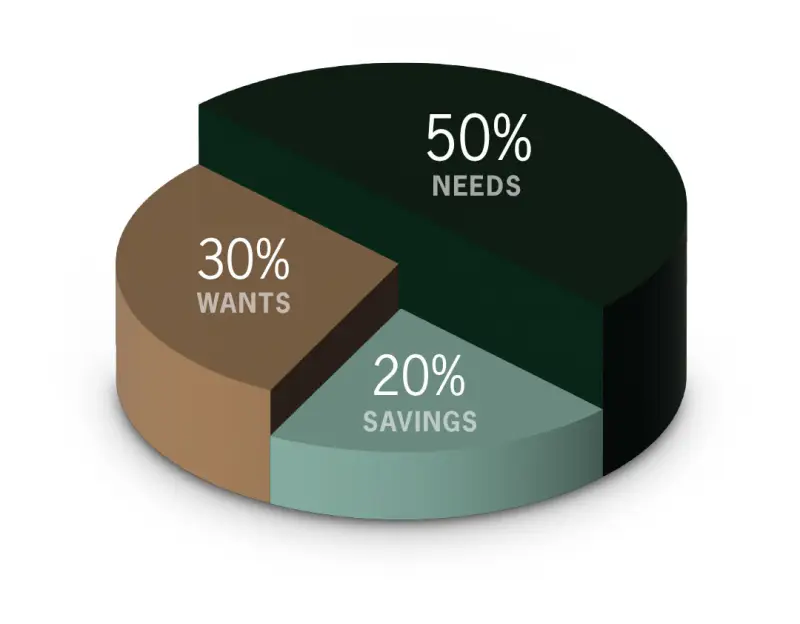
The 50/30/20 budget rule is a simple way to divide your monthly take-home income between essential expenses, lifestyle spending, and financial goals.
The basic idea is:
50% for needs
30% for wants
20% for savings and financial goals
For example, if your monthly take-home income is $5,000, the guideline would allocate $2,500 to needs, $1,500 to wants, and $1,000 to savings or other financial goals.
The percentages are not strict requirements. Think of the 50/30/20 budget rule as a starting point that can help you understand where your money is going and where you may want to make adjustments.
How Does the 50/30/20 Budget Rule Work?
The 50/30/20 budget rule divides your after-tax or take-home income into three broad categories.
For a $5,000 monthly income:
| Category | Percentage | Monthly Amount |
|---|---|---|
| Needs | 50% | $2,500 |
| Wants | 30% | $1,500 |
| Savings and goals | 20% | $1,000 |
| Total | 100% | $5,000 |
This gives you a simple framework for evaluating your monthly spending.
If you are not currently tracking your expenses, start with our How to Create a Simple Monthly Budget guide.
What Counts as Needs?
Needs are expenses that are generally necessary for everyday life and basic financial obligations.
They may include:
- Rent or mortgage
- Groceries
- Utilities
- Transportation
- Insurance
- Essential medications
- Basic childcare
- Minimum required debt payments
Suppose your monthly needs are:
Housing: $1,500
Groceries: $450
Utilities: $200
Transportation: $200
Insurance: $150
Total: $2,500
That fits the 50% target in our $5,000 example.
However, your real expenses may be higher or lower.
If housing alone takes up 40% of your income, keeping all essential expenses below 50% may be difficult. That does not mean you have failed at budgeting.
What Counts as Wants?
Wants are expenses that improve your lifestyle but could usually be reduced or delayed if necessary.
Examples include:
- Dining out
- Entertainment
- Streaming subscriptions
- Vacations
- Hobbies
- Nonessential shopping
- Premium upgrades
The distinction between a need and a want is not always perfect.
You may need a phone for work, for example, but upgrading to the newest premium model every year may be a lifestyle choice.
The goal is not to judge your spending. It is to understand it.
What Does the 20% Category Include?
Under the 50/30/20 budget rule, 20% of income is generally directed toward savings and financial goals.
Possible uses include:
- Emergency savings
- Retirement contributions
- Additional debt repayment
- Major future purchases
- Other long-term savings goals
With $5,000 of monthly take-home income:
20% = $1,000 per month
Over 12 months, that would equal: $12,000
before considering interest, investment gains or losses, or other changes.
What If You Cannot Save 20%?
You do not need to abandon your budget simply because 20% is unrealistic today.
For a $5,000 monthly income:
5% = $250
10% = $500
15% = $750
20% = $1,000
If you can comfortably save only 5%, start there.
You could gradually increase the amount as your income rises, debt decreases, or other expenses change.
For a deeper breakdown, read How Much Should You Save Each Month?
How to Adjust the 50/30/20 Budget Rule
The 50/30/20 budget rule works best as a flexible guideline rather than a rigid formula.
Suppose your actual budget looks like:
Needs: 60%
Wants: 25%
Savings: 15%
That may still be a perfectly reasonable budget for your circumstances.
Someone living in an expensive city may spend more on housing, while another household may have unusually high childcare or healthcare costs.
Instead of forcing your finances into exact percentages, use the framework to identify opportunities.
Ask:
- Are my essential expenses manageable?
- Am I spending more on wants than I realized?
- Can I increase savings gradually?
- Are there recurring expenses I no longer use?
- Do I have an emergency fund?
Build Emergency Savings Into Your Budget
If you do not have emergency savings yet, part of your savings category can be directed toward building a financial cushion.
You might start with: $500
then: $1,000
then: One month of essential expenses
and gradually work toward a larger reserve if appropriate for your situation.
Our guide on How to Build an Emergency Fund on a Tight Budget explains how to start even when you cannot save a large amount each month.
Is the 50/30/20 Budget Rule Right for Everyone?
No budgeting method works perfectly for everyone.
The 50/30/20 budget rule may be useful if you want a simple framework without tracking dozens of individual spending categories.
However, you may need a different approach if you have:
- Very high housing costs
- Large debt payments
- Irregular income
- Significant medical expenses
- High childcare costs
- Aggressive savings goals
Your actual financial situation should determine your budget—not the other way around.
Final Takeaway
The 50/30/20 budget rule provides a simple starting point for managing money:
50% → Needs
30% → Wants
20% → Savings and financial goals
But those percentages are guidelines, not requirements.
If your current budget is 60/25/15 or even 70/20/10, understanding those numbers is already useful.
The goal is to build a budget you can realistically maintain while gradually working toward your financial priorities.
Financial disclaimer: This article is for general educational and informational purposes only and should not be considered personalized financial advice. Financial circumstances vary, so consider your own needs and consult a qualified professional when appropriate.