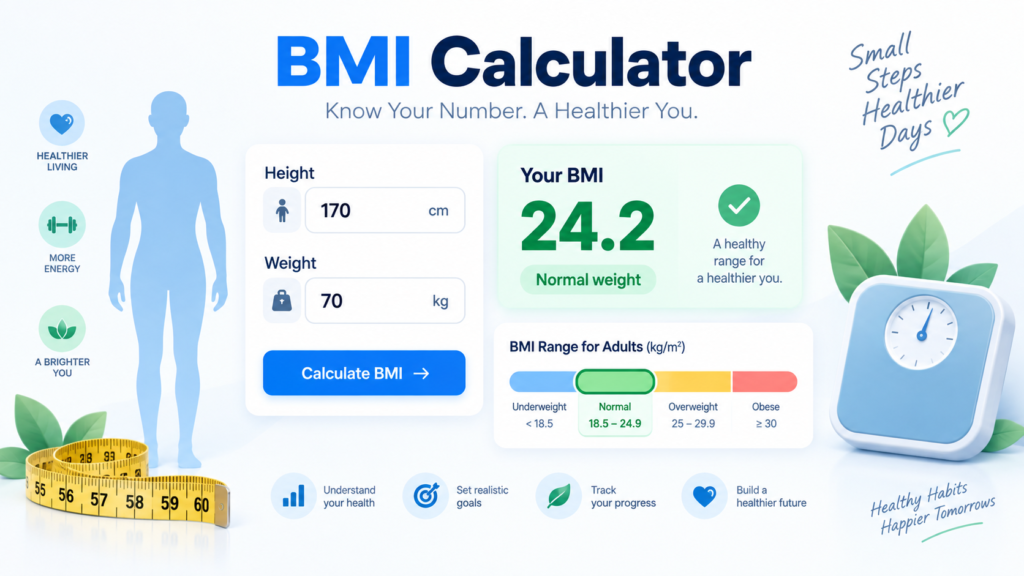
Body mass index, commonly called BMI, is a simple calculation that compares a person’s weight with their height.
It is widely used as a screening measurement because it is quick and inexpensive.
But BMI isn’t a diagnosis, and it doesn’t directly measure body fat.
That’s an important distinction.
The CDC describes BMI as a screening measure that should be considered alongside other factors when assessing someone’s health.
How Is BMI Calculated?
If you’re using pounds and inches, the formula is:
BMI = weight in pounds ÷ height² in inches × 703
For metric measurements:
BMI = weight in kilograms ÷ height² in meters
Let’s use an example.
Suppose an adult weighs 180 pounds and is 5 feet 10 inches, or 70 inches tall.
First:
70 × 70 = 4,900
Then:
180 ÷ 4,900 = approximately 0.03673
Finally:
0.03673 × 703 = approximately 25.8
That person’s calculated BMI would therefore be about 25.8.
Don’t want to calculate it manually?
Use the DailyFeedNow BMI Calculator to enter your height and weight and get a result instantly.
What Do Adult BMI Numbers Mean?
For adults aged 20 and older, the CDC currently uses the following screening categories:
| BMI | Adult category |
|---|---|
| Below 18.5 | Underweight |
| 18.5 to 24.9 | Healthy Weight |
| 25.0 to 29.9 | Overweight |
| 30.0 or higher | Obesity |
The obesity category is further divided into classes, but the important point is that these numbers are screening classifications, not medical diagnoses.
A BMI of 25.8, for example, falls in the CDC’s overweight screening category.
That alone does not tell you everything about a person’s health.
Why Doesn’t BMI Tell the Whole Story?
BMI uses only height and weight.
It does not directly distinguish between muscle, body fat, bone mass, or where body fat is distributed.
Consider two people who weigh the same and are the same height.
One may have more muscle.
The other may have a higher body-fat percentage.
Their BMI could still be identical.
This is one reason BMI should be interpreted as one piece of information rather than a complete health assessment.
What About Muscular People?
Someone with substantial muscle mass can have a relatively high BMI even when their body composition is very different from another person with the same BMI.
For example, some athletes may fall into an “overweight” BMI category primarily because muscle adds body weight.
That doesn’t mean BMI becomes completely useless.
It means the result needs context.
A healthcare professional may consider other information such as medical history, blood pressure, laboratory results, body composition, waist measurement, activity level, and other health indicators when appropriate.
Is BMI Used the Same Way for Children?
No.
The simple adult categories above apply to adults age 20 and older.
For children and teenagers ages 2 through 19, BMI is interpreted differently using age- and sex-specific percentiles. For this reason, the CDC maintains a separate Child and Teen BMI Calculator.
That means you should not simply apply an adult BMI table to a child.
BMI vs. Body-Fat Percentage
BMI and body-fat percentage measure different things.
BMI is based on:
weight + height
Body-fat percentage attempts to estimate:
the proportion of the body made up of fat
A person could therefore have the same BMI as someone else while having a different body-fat percentage.
Each measurement also has its own limitations.
That’s why health should not be reduced to one number.
When Can BMI Still Be Useful?
Despite its limitations, BMI remains useful as a quick screening tool, particularly when considered alongside other health information.
It can help identify situations where it may be worth having a broader conversation about weight and health with a qualified healthcare professional.
The key word is screening.
BMI can provide information.
It should not be treated as a complete diagnosis.
Calculate Your BMI
You can calculate BMI manually using the formulas above, but the fastest method is our free BMI Calculator.
Enter your height and weight, and the tool will calculate your BMI and display the corresponding adult screening category.
Final Takeaway
BMI is a simple measurement based on height and weight.
It can provide a useful starting point for understanding weight-related screening categories, but it cannot tell you everything about body composition or overall health.
Use the number as context—not as a complete judgment about your health.
Medical disclaimer: This article and the DailyFeedNow BMI Calculator are provided for general educational purposes only. They are not intended to diagnose, treat, prevent, or replace professional medical advice. Speak with a qualified healthcare professional if you have questions about your weight, BMI, or health.


