Table of Contents
The difference between a sinking fund vs emergency fund may sound small, but understanding it can change how you handle large expenses.
Both involve saving money before you need it — the difference is why you’re saving. An emergency fund covers expenses you didn’t see coming. A sinking fund is money you set aside on purpose for something you know is coming.
Think about your car. New tires next year? You can plan for that. A transmission that fails tomorrow? That’s a different situation — one belongs in a sinking fund, the other calls for emergency savings.
Understanding that distinction makes your budget easier to manage.
Sinking Fund vs Emergency Fund: What’s the Real Difference?
The easiest way to understand a sinking fund vs emergency fund is to think about two words: planned and unexpected.
A sinking fund prepares you for a future expense you can reasonably anticipate, even before you know the exact amount. An emergency fund protects you when life delivers something you didn’t plan for.
The Consumer Financial Protection Bureau frames it simply: this money exists purely for unplanned costs — a car repair, a home repair, a medical bill, income that suddenly stops — not for anything you saw coming.
What a Sinking Fund Looks Like in Real Life
Suppose your annual car insurance bill is $1,200, due in 12 months. Without planning, it can feel like an emergency when it arrives, but it isn’t really unexpected.
Save $100 a month and you’ll have the full $1,200 ready when the bill is due. That’s a sinking fund at work, and the same idea applies to holiday spending, travel, annual subscriptions, school expenses, car maintenance, or replacing an aging appliance.
Instead of a surprise $1,200 hit, you get a predictable monthly cost.
Your Emergency Fund Has a Different Job
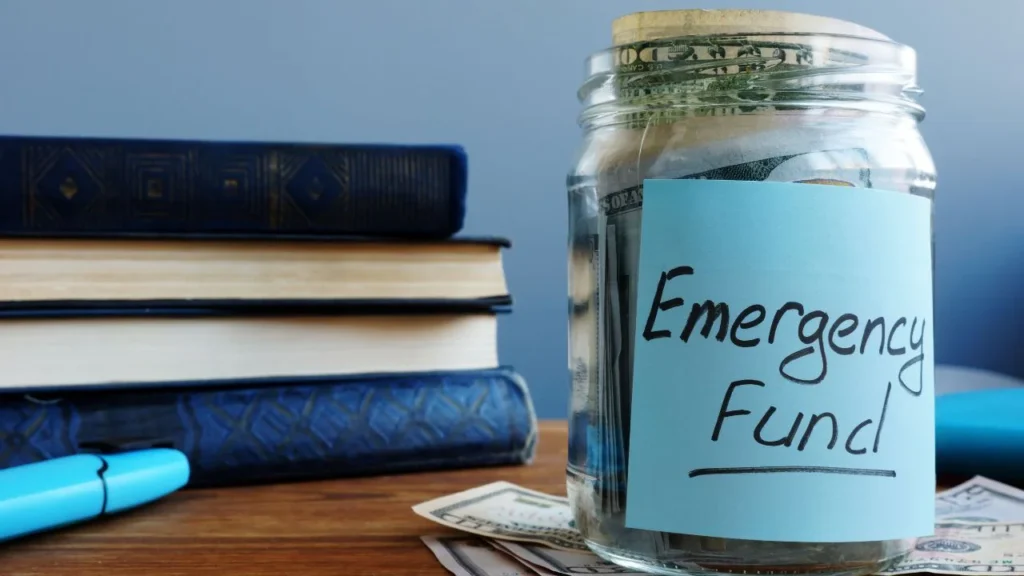
Now imagine something different: your car breaks down and needs a $1,400 repair you couldn’t have predicted. You depend on it to get to work, so waiting isn’t an option — this is exactly the kind of situation emergency savings exist for.
An emergency fund lets you absorb financial shocks without automatically reaching for a credit card or loan. And the CFPB is clear that you don’t need a large balance to benefit — even modest savings offer real financial security when something unexpected hits.
That’s why your emergency fund shouldn’t become the account you dip into for every large bill. Some big expenses are true emergencies; others are just predictable costs that happen infrequently.
Why Your Budget May Need Both
Consider what happens if two expenses land in the same month. You need $800 for new tires, something you knew was coming, and a week later your water heater unexpectedly fails, costing $1,500 to fix.
Without a sinking fund, you might pull $800 from emergency savings for the tires, then have far less cushion left when the water heater goes. But if you had already been saving for car maintenance, the tires come from that sinking fund, and the water heater repair comes from your emergency fund instead.
Same expenses, same month, much less financial disruption. That’s the real advantage of using both.
A Sinking Fund Can Make “Emergencies” Less Common
One of the most useful things about sinking funds is that they force you to look ahead. Car registration, holidays, appliance replacements, home maintenance, insurance renewals — none of these should be a surprise just because they don’t happen every month.
Say you want to spend $600 over the holidays. Saving $50 a month starting in January gets you there by December, a very different experience than scrambling to find $600 in December.
The formula works for almost any predictable expense: future cost divided by months until you need it equals your monthly sinking-fund contribution. Simple planning turns a future expense into a non-event, not a crisis.
What If You Are Just Starting to Save?
You don’t need five different savings accounts on day one. If you have little or no savings right now, building a modest emergency cushion is probably the best place to start — aim for $500, then $1,000, then a larger reserve that fits your household.
At the same time, look ahead six to twelve months. Is your car insurance renewing? Do you need new tires? Is there a trip, school expense, or annual bill you already know about? Those are good candidates for a sinking fund.
If you’re not sure where to start on the emergency-fund side, our guide on how to build an emergency fund on a tight budget walks through it step by step.
You Don’t Need a Perfect System
Personal finance doesn’t need to be complicated. You don’t need a perfect system — some people prefer separate accounts for each goal, and others keep multiple sinking funds in one account, tracked with a spreadsheet or app.
What matters is knowing which money is already spoken for. If your savings account holds $5,000 but $2,000 is earmarked for insurance, travel, and car maintenance, you don’t really have $5,000 available for emergencies — you have $3,000. Giving your money a purpose makes that distinction clear.
Final Takeaway
The simplest way to remember sinking fund vs emergency fund: a sinking fund prepares you for something you expect; an emergency fund protects you from something you don’t. Both play an important role in a healthy budget: sinking funds smooth out large predictable expenses, while emergency savings give you a cushion when life doesn’t go according to plan.
You don’t have to build everything at once. Start with the expense most likely to cause you stress, save consistently, and give more of your money a purpose over time. Fewer large bills will feel like emergencies, and your finances will feel a lot less stressful.
Financial Disclaimer: This article is for general educational and informational purposes only and is not personalized financial advice. Individual financial circumstances vary.