
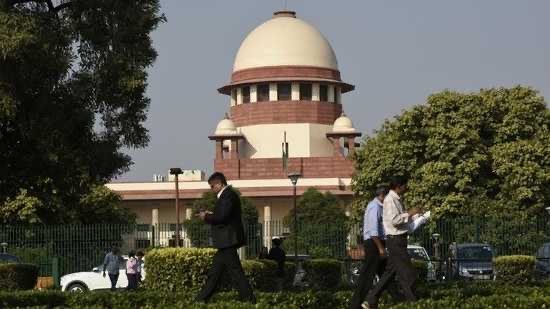
The Supreme Court of India has clarified that the deletion of a person’s name from the electoral roll does not automatically result in the loss of Indian citizenship. The court observed that while the Election Commission of India (ECI) has the authority to maintain and revise electoral rolls, questions relating to citizenship must be decided by the competent authority under the Central Government.
The clarification came during the hearing of a petition concerning voters who were removed from electoral rolls and allegedly denied access to welfare benefits.
Supreme Court’s Key Observation
A Bench headed by Chief Justice of India Surya Kant, along with Justices Joymalya Bagchi and V. Mohana, reiterated that the Election Commission has complete control over electoral rolls. However, the court emphasized that deletion from the voters’ list does not by itself determine a person’s citizenship status.
The Bench observed:
“Deletion from the electoral roll does not result in loss of citizenship. The Election Commission has a corresponding duty to refer such cases to the competent authority under the Central Government for adjudication of citizenship status.”
The court said citizenship can only be decided through the legal process prescribed under the law and not merely on the basis of removal from the electoral roll.
Petition Linked to West Bengal Voters
The observations were made while hearing a petition seeking a mechanism for the speedy disposal of appeals filed by more than three million voters in West Bengal who were allegedly removed from electoral rolls and consequently excluded from subsidised ration, cash transfer schemes, and other welfare benefits.
The petitioner argued that many citizens were facing hardship because their names had been deleted from the voter list while their appeals remained pending.
Bihar SIR Judgment Referenced
The Supreme Court referred to its earlier judgment concerning the Special Intensive Revision (SIR) of electoral rolls in Bihar.
According to the Bench, the earlier ruling clearly stated that while the Election Commission is empowered to revise electoral rolls, it must refer doubtful citizenship cases to the appropriate Central Government authority rather than treating deletion as a final determination of citizenship.
Concerns Raised Before the Court
Senior Advocate Gopal Sankaranarayanan, appearing for the petitioner, argued that despite the Supreme Court’s earlier clarification, the West Bengal government had issued orders affecting benefits under welfare schemes, including:
- Public Distribution System (PDS)
- Annapurna cash transfer scheme
- Other state welfare programmes
The petitioner contended that these measures had adversely affected thousands of families while appeals were still pending.
Demand for Faster Appeal Process
The petition sought an expedited mechanism for deciding nearly 3.4 million appeals filed by voters excluded during the electoral roll revision exercise.
The petitioner also pointed out that:
- Nineteen appellate tribunals had been constituted.
- There was no publicly available data regarding the number of appeals disposed of.
- The Standard Operating Procedure (SOP) governing these tribunals had not been made public.
An increase in the number of appellate tribunals—from 19 to at least 42—was also requested to ensure timely disposal before upcoming local body elections.
Supreme Court’s Response
The Bench observed that the SOP was meant primarily for internal functioning and that concerns regarding its implementation were being addressed by the Chief Justice of the Calcutta High Court.
The judges clarified that the court’s immediate concern was ensuring the timely disposal of pending appeals, particularly with local body elections in West Bengal expected later this year.
The Supreme Court agreed to hear the matter along with pending petitions challenging the electoral roll revision process in West Bengal during the next scheduled hearing.
Why the Judgment Matters
The Supreme Court’s clarification reinforces an important constitutional principle:
- Deletion from the electoral roll does not cancel Indian citizenship.
- Citizenship disputes must be determined only through the legal process.
- The Election Commission’s role is limited to maintaining electoral rolls.
- Welfare benefits should not be denied solely because a person’s name has been removed from the voters’ list without due legal determination.
The ruling provides reassurance to individuals whose names have been removed from electoral rolls while their legal status remains under consideration.
Conclusion
The Supreme Court’s latest observations underscore the distinction between voting rights and citizenship. While electoral rolls may be revised by the Election Commission, the court has made it clear that citizenship cannot be taken away through administrative deletion alone. As the case proceeds, the focus will remain on ensuring a fair, transparent, and time-bound process for deciding appeals while protecting the legal rights of affected citizens.