In this article
- What Is Generative AI?
- How Does Generative AI Work?
- What Is a Prompt?
- What Can Generative AI Create?
- Generative AI vs. Traditional AI
- Generative AI vs. AI Agents
- Why Has Generative AI Become So Popular?
- How Generative AI Can Save Time
- Generative AI for Research
- What Are the Benefits of Generative AI?
- What Are the Limitations?
- Is Generative AI Free?
- Should You Trust Generative AI?
- Will Generative AI Replace People?
- The Future of Generative AI
- Final Thoughts
Generative AI has quickly become one of the most talked-about technologies in the world.
People are using it to write emails, create images, summarize documents, generate computer code, brainstorm ideas, research topics, and assist with everyday work.
But what exactly does generative AI mean?
In simple terms, generative AI is a type of artificial intelligence that can create new content based on instructions from a user.
That content might be text, an image, code, audio, video, or another form of digital information.
Instead of only analyzing existing information, generative AI can produce something new.
What Is Generative AI?
Generative AI refers to artificial intelligence systems designed to generate new content.
You provide an instruction, usually called a prompt, and the system produces a response.
For example, you might ask an AI system to:
“Explain compound interest in simple language.”
The AI could generate a new explanation based on patterns it learned during training.
You could also ask:
“Write a professional follow-up email after a job interview.”
Or:
“Create an illustration of a futuristic city powered by renewable energy.”
Although the requests are different, the basic process is similar.
The AI receives your instruction, interprets what you want, and generates an output.
How Does Generative AI Work?
Generative AI systems are trained using large amounts of information.
Depending on the model, that information may include text, images, computer code, audio, or other data.
During training, the system learns patterns.
For a language model, those patterns may involve how words relate to one another, how sentences are structured, how questions are answered, and how different types of writing are organized.
When you enter a prompt, the model uses those learned relationships to generate a response.
It is important to understand that this does not mean the system simply looks up a stored paragraph and copies it.
Instead, it generates an output based on patterns and probabilities learned during training.
That ability allows the same system to answer an enormous variety of questions and respond to instructions it may never have seen in the same form before.
What Is a Prompt?
A prompt is simply the instruction you give to an AI system.
A basic prompt might be:
“Write an email.”
That may produce a usable result, but the AI has very little context.
A stronger prompt might say:
“Write a short professional email asking a client to confirm whether they are available for a 30-minute meeting Tuesday afternoon. Keep the tone friendly and direct.”
The second prompt gives the AI much more information.
It explains what you want, who the message is for, how long it should be, and what tone to use.
In many cases, better instructions lead to better results.
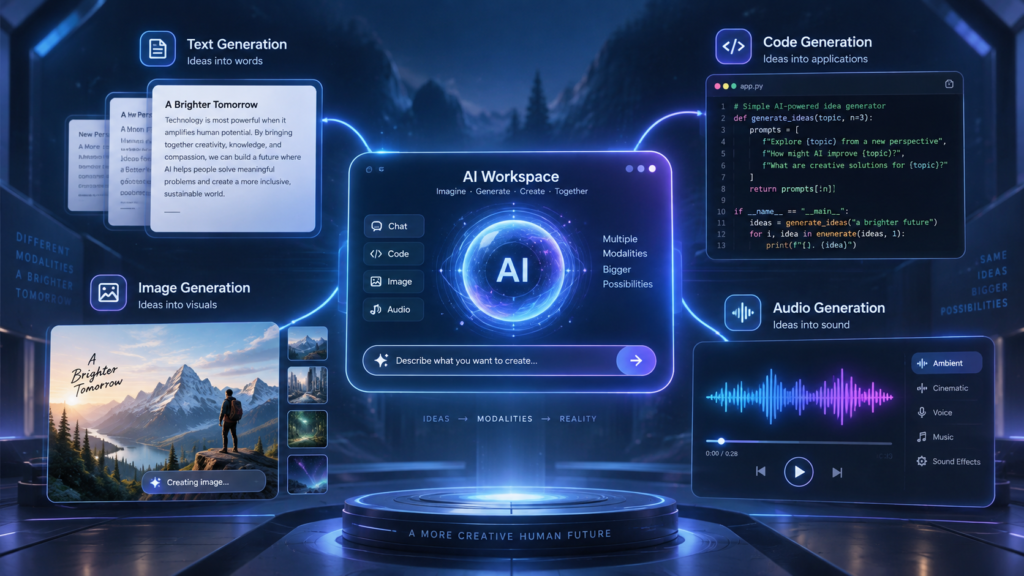
What Can Generative AI Create?
Generative AI is not limited to text.
Different systems can create different forms of digital content.
Text
Text-based generative AI can help create:
Emails, reports, summaries, social media posts, product descriptions, outlines, explanations, ideas, and other written content.
It can also rewrite existing material.
For example, you might ask AI to make a paragraph shorter, more professional, easier to understand, or better suited to a particular audience.
Images
Image-generation systems can create visuals from written descriptions.
A user might request:
“A clean illustration of a modern home office with an AI productivity dashboard.”
The system can generate a new image based on that description.
Computer Code
Generative AI can assist with programming by generating example code, explaining existing code, suggesting fixes, and helping developers think through technical problems.
AI-generated code should still be reviewed and tested before being used in important applications.
Audio
Some generative AI systems can produce speech, music, sound effects, and other audio.
This can be useful for narration, accessibility, media production, and creative projects.
Video
AI-generated video is also developing rapidly.
Some systems can create short video clips from written instructions or help modify existing footage.
The technology continues to improve, although quality and capabilities vary significantly between tools.
Generative AI vs. Traditional AI
Not all artificial intelligence is generative AI.
Traditional AI systems often focus on classification, prediction, recognition, or optimization.
For example, an AI system may determine whether an email is spam.
Another may detect suspicious financial transactions.
Another may recommend products based on previous purchases.
Generative AI focuses more heavily on creating new output.
A simple comparison looks like this:
Traditional AI might identify whether an image contains a dog.
Generative AI might create a completely new image of a dog based on your description.
Traditional AI might determine whether an email is spam.
Generative AI might write the email itself.
Both approaches use artificial intelligence, but they solve different types of problems.
Generative AI vs. AI Agents
Generative AI and AI agents are closely related, but they are not the same thing.
Generative AI primarily creates content.
An AI agent may use generative AI as part of a larger process that includes planning and taking actions.
For example, generative AI could write a meeting invitation.
An AI agent might be able to check your calendar, identify available time slots, prepare the invitation, create the event, and send it after receiving appropriate permission.
For a deeper explanation, read What Is an AI Agent? A Simple Explanation.
Why Has Generative AI Become So Popular?
One reason is accessibility.
You no longer need advanced programming skills to interact with powerful AI systems.
You can simply describe what you want in everyday language.
That has made artificial intelligence useful to a much broader group of people.
Writers can use AI for brainstorming.
Business owners can use it to draft marketing ideas.
Students can ask for explanations.
Developers can get help understanding code.
Professionals can summarize long documents or prepare first drafts.
Generative AI has effectively turned natural language into a new way of interacting with software.
How Generative AI Can Save Time
One of the biggest practical benefits is productivity.
AI can reduce the time spent on repetitive initial steps.
For example, instead of starting an email from a blank page, you can ask AI for a first draft.
Instead of manually organizing a page of meeting notes, you can ask AI to identify decisions and action items.
Instead of spending 20 minutes brainstorming headlines, you can generate several options in seconds.
For more practical examples, read 5 Ways AI Can Save You Time Every Day.
Generative AI for Research
Generative AI can also help people learn unfamiliar subjects more quickly.
Suppose you want to understand cybersecurity.
You could begin with:
“Explain cybersecurity for a beginner and cover the five most important concepts.”
That gives you a starting framework.
You could then ask:
“What is phishing?”
or:
“How is ransomware different from malware?”
This conversational format makes it easier to explore a subject step by step.
However, AI-generated information should not automatically be treated as a reliable source.
Important claims should still be checked against credible primary or authoritative sources.
What Are the Benefits of Generative AI?
Generative AI can provide several practical benefits.
It can make common tasks faster, help people overcome blank-page problems, simplify difficult information, create multiple ideas quickly, and make advanced software easier to use.
It can also help people adapt content for different audiences.
A complicated explanation could be rewritten for beginners.
A long document could be summarized.
A rough idea could become a structured outline.
The value often comes from using AI as an assistant rather than expecting it to replace human thinking.
What Are the Limitations?
Generative AI is powerful, but it is not perfect.
It Can Be Wrong
AI can sometimes generate information that sounds convincing but is inaccurate.
This is why fact-checking remains important.
It May Misunderstand Context
A model may technically understand the words in your request but still misunderstand what you actually intended.
Providing more context can help, but human review is still necessary.
It Can Reflect Bias
AI systems may reproduce biases present in training data or those that emerge from how the model was designed.
Privacy Matters
Users should be cautious about entering confidential information, passwords, sensitive customer information, or proprietary business data into AI tools.
Content Can Become Generic
If AI-generated writing is published without editing, it may sound repetitive or lack a distinctive point of view.
Human experience and judgment remain valuable.
Is Generative AI Free?
Many AI platforms provide some level of free access.
Free plans often include usage limits on advanced models, image generation, file uploads, research capabilities, or other premium features.
If you want to explore several options, read our guide to Best Free AI Tools to Try Right Now.
For beginners, free plans are often enough to experiment with AI and learn where it provides real value.
Should You Trust Generative AI?
Generative AI can be extremely useful, but trust should depend on the task.
Asking AI to brainstorm birthday ideas carries relatively little risk.
Using an AI-generated answer to make an important financial, medical, legal, or security decision carries much greater risk.
The importance of verification should increase with the consequences of the decision.
Use AI to assist your thinking.
Do not automatically replace judgment with an AI-generated response.
Will Generative AI Replace People?
The more realistic near-term question is how generative AI will change individual tasks.
A marketing professional may still create strategy while AI assists with drafts and research.
A software developer may still design and approve systems while AI helps write boilerplate code or tests.
A customer service professional may focus on difficult cases while AI handles common questions.
Many jobs may evolve as AI becomes incorporated into everyday software.
Learning how to work effectively with AI may therefore become increasingly valuable.
The Future of Generative AI
Generative AI is likely to become less visible as a separate category of software.
Instead, it may simply become part of the applications people already use.
AI features are increasingly appearing in writing tools, productivity software, search, design applications, coding environments, customer service platforms, and business systems.
Eventually, many people may use generative AI regularly without thinking about it as a separate AI product.
Final Thoughts
Generative AI is a form of artificial intelligence that can create new content based on user instructions.
It can generate text, images, audio, code, video, and other forms of information.
Its biggest advantage is accessibility.
People can interact with powerful AI systems simply by describing what they want.
However, AI-generated content still requires judgment.
It can be inaccurate, biased, incomplete, or inappropriate for the situation.
The best approach is to use generative AI as an assistant.
Let it help with repetitive work, ideas, drafts, explanations, and organization.
Then apply human judgment before important information is published, shared, or acted upon.