Table of Contents
AI tools can help you understand unfamiliar topics, summarize information, generate research questions, organize notes, compare ideas, and simplify complicated material. That makes them useful for students, professionals, business owners, writers, and anyone trying to learn faster.
But there is an important limitation.
AI-generated answers should not automatically be treated as verified facts.
An AI system may produce a response that sounds confident even when part of the information is incomplete, outdated, misunderstood, or simply incorrect.
That is why learning how to use AI for research is not just about asking better questions. It is also about knowing when to verify information and where to look for trustworthy evidence.
The best approach is to use AI as a research assistant, not as your only source of truth.
How to Use AI for Research Effectively
One of the biggest advantages of AI is speed.
You can take a complicated topic and ask an AI assistant to explain it in plain language within seconds.
For example, instead of searching through dozens of articles before you even understand the terminology, you could ask:
Explain cloud computing to a beginner. Define the five most important terms I should understand before researching the topic further.
The AI might explain terms such as cloud storage, servers, software as a service, scalability, and data centers.
Once you understand the basics, you are in a much better position to research the subject in greater depth.
This is one of the best ways to use AI: build a foundation first, then investigate the details.
How to Use AI for Research With Better Questions
A large part of learning how to use AI for research is learning how to ask clear questions.
Broad prompts usually produce broad answers.
For example:
Tell me about emergency funds.
That might give you a general explanation, but it does not tell the AI what you really want to know.
A stronger prompt would be:
Explain how emergency funds work for someone with irregular monthly income. Include the main benefits, possible challenges, and five questions I should research further.
The second prompt gives the AI more direction.
It explains:
- The topic
- The audience
- The situation
- The type of answer you want
- The next research step
Clearer instructions usually produce more useful results.
If you want to improve your AI prompts further, Prompt Engineering for Beginners guide.
Use AI to Understand a Topic Before Going Deeper
AI is especially helpful when you are entering a subject you know very little about.
Suppose you want to research investing, cybersecurity, machine learning, personal finance, or digital marketing.
Instead of immediately asking for a final answer, start with:
Give me a beginner-friendly overview of this topic. Explain the most important terms and the five concepts I should understand before researching further.
This gives you a map of the subject.
You can then investigate each concept individually.
That is often more effective than asking AI to solve the entire research problem in one prompt.
Ask AI to Generate Research Questions
Another useful approach is to ask AI what questions you should investigate.
Imagine you are researching whether a small business should move from locally installed software to cloud-based software.
You might ask:
I am researching whether cloud software is a good choice for a small business. Give me 10 questions I should answer before reaching a conclusion.
The AI may suggest questions about:
- Pricing
- Security
- Data ownership
- Reliability
- Backups
- Vendor dependence
- Accessibility
- Scalability
- Support
- Integration with existing systems
Now you have a research checklist.
Instead of relying on one AI-generated conclusion, you can investigate each question using reliable sources.
That makes the research process much stronger.
How to Use AI for Research Without Trusting Everything It Says
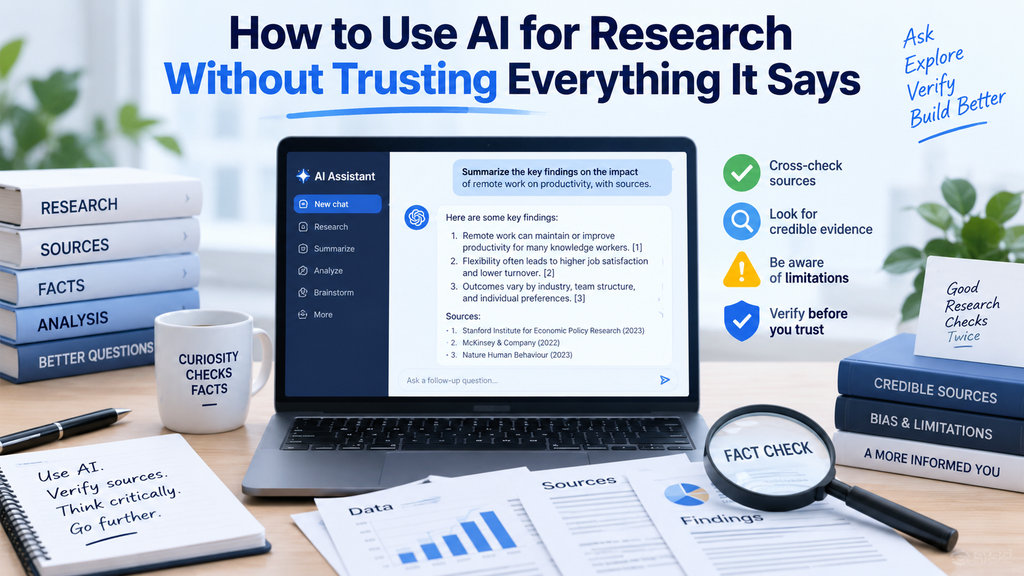
Knowing how to use AI for research also means knowing when to be skeptical.
Not every claim requires the same level of verification.
General explanations may be relatively stable.
But certain types of information can change quickly or have serious consequences.
Pay extra attention to claims involving:
- Prices
- Dates
- Statistics
- Laws
- Regulations
- Taxes
- Interest rates
- Medical information
- Financial information
- Product specifications
- Software features
- Company announcements
For example, imagine an AI tool tells you:
A software subscription costs $20 per month.
Before publishing that statement, visit the company’s official pricing page.
If AI says a government program has a particular eligibility rule, verify it on the relevant government website.
The more important the claim, the stronger your verification should be.
Ask AI to Separate Facts From Opinions
AI responses often mix facts, interpretation, and recommendations.
It helps to separate them.
For example:
This budgeting method is the best option for everyone.
That is a recommendation.
Compare it with:
A budget helps organize income, expenses, savings, and other financial priorities.
That is a general explanation.
You can ask AI:
Separate your answer into verified facts, general explanations, opinions, and recommendations.
You can also ask:
Which parts of your answer should I independently verify?
This does not guarantee that the AI will identify every potential problem, but it can encourage a more careful response.
How to Use AI for Research and Verify the Results
A simple research workflow can make AI much more useful.
Step 1: Get an Overview
Ask AI for a beginner-friendly explanation of the topic.
Step 2: Identify Key Questions
Ask which questions you should answer before reaching a conclusion.
Step 3: Find Reliable Sources
Use official websites, original documents, trusted institutions, research papers, or other authoritative sources when appropriate.
Step 4: Compare What You Find
AI can help organize multiple pieces of information.
For example:
Compare these three explanations and show where they agree and disagree.
Step 5: Verify Important Claims
Check dates, statistics, pricing, regulations, health information, financial information, and other high-impact claims before relying on them.
This workflow lets you benefit from AI’s speed while keeping human judgment in the process.
Compare Multiple Perspectives
Good research rarely depends on only one perspective.
Suppose you are researching whether AI improves workplace productivity.
You could ask:
Give me the strongest arguments for AI improving workplace productivity.
Then ask:
Give me the strongest arguments for why AI may not improve productivity in every workplace.
Finally:
What evidence would help determine which argument is stronger?
This approach helps reduce confirmation bias.
Instead of using AI to support what you already believe, you use it to explore the issue from multiple angles.
Never Assume an AI-Generated Citation Is Correct
This is one of the most important rules when learning how to use AI for research.
If an AI tool mentions a study, report, article, organization, or statistic, verify that the source actually exists.
Do not cite something simply because the reference looks professional.
Check:
- The author
- The publisher
- The publication date
- The original document
- Whether the source actually supports the claim
AI-generated citations can sometimes be incomplete, incorrect, or mismatched with the statement they supposedly support.
Open the source before using it.
Keep a Simple Research Record
If you are writing an article or report, keep track of what you verified.
You could use a simple table:
| Claim | Verified? | Source |
|---|---|---|
| Product price | Yes | Official pricing page |
| Industry statistic | Yes | Research report |
| Software feature | Yes | Official documentation |
| General explanation | Reviewed | Multiple references |
This becomes especially useful when you update an article later.
You will know which claims are likely to need another check.
Use AI to Organize Your Findings
Once you have collected reliable information, AI can be extremely useful for organization.
You might ask:
Organize these notes into five themes.
Or:
Turn these research notes into an outline without adding any new facts.
Or:
Compare these sources and identify the main areas of agreement.
This is often a safer use of AI because you are giving the system information you have already collected and asking it to organize that material.
Still, review the result before publishing it.
Protect Sensitive Information
Research sometimes involves private or confidential information.
Be careful about entering sensitive data into AI tools.
Avoid sharing information such as:
- Passwords
- Private customer records
- Confidential business documents
- Banking information
- Medical records
- Personal identification numbers
- Proprietary data
Before using an AI tool with sensitive information, understand its privacy and data-handling policies.
When possible, remove identifying or confidential details.
How AI Can Make Research Faster
Used carefully, AI can save time during several parts of research.
It can help you:
- Understand unfamiliar concepts
- Generate research questions
- Create outlines
- Summarize your own notes
- Compare information
- Identify missing questions
- Rewrite complicated explanations
- Organize findings
- Brainstorm examples
A Simple AI Research Checklist
Before relying on an AI-generated answer, ask yourself:
Did I clearly define the research question?
Did I verify important facts?
Did I check whether the information is current?
Did I use an authoritative source where appropriate?
Did I compare more than one perspective?
Did I verify citations before using them?
Did I review the final conclusion myself?
If the answer is yes, you are much less likely to rely blindly on inaccurate information.
Final Takeaway
Learning how to use AI for research is not about letting artificial intelligence do all the thinking for you.
AI is most useful when it helps you:
Understand → Question → Organize → Compare
Then you add the most important step:
Verify.
Use AI to explore unfamiliar subjects, generate better questions, organize your findings, and speed up repetitive research tasks.
But when information affects money, health, business decisions, regulations, or other important choices, verify the facts independently.
AI can make research much faster.
Good research still requires human judgment.
Related reading: Prompt Engineering for Beginners · Best Free AI Tools to Try Right Now · What Is Generative AI? · AI vs. Machine Learning · 5 Ways AI Can Save You Time Every Day