
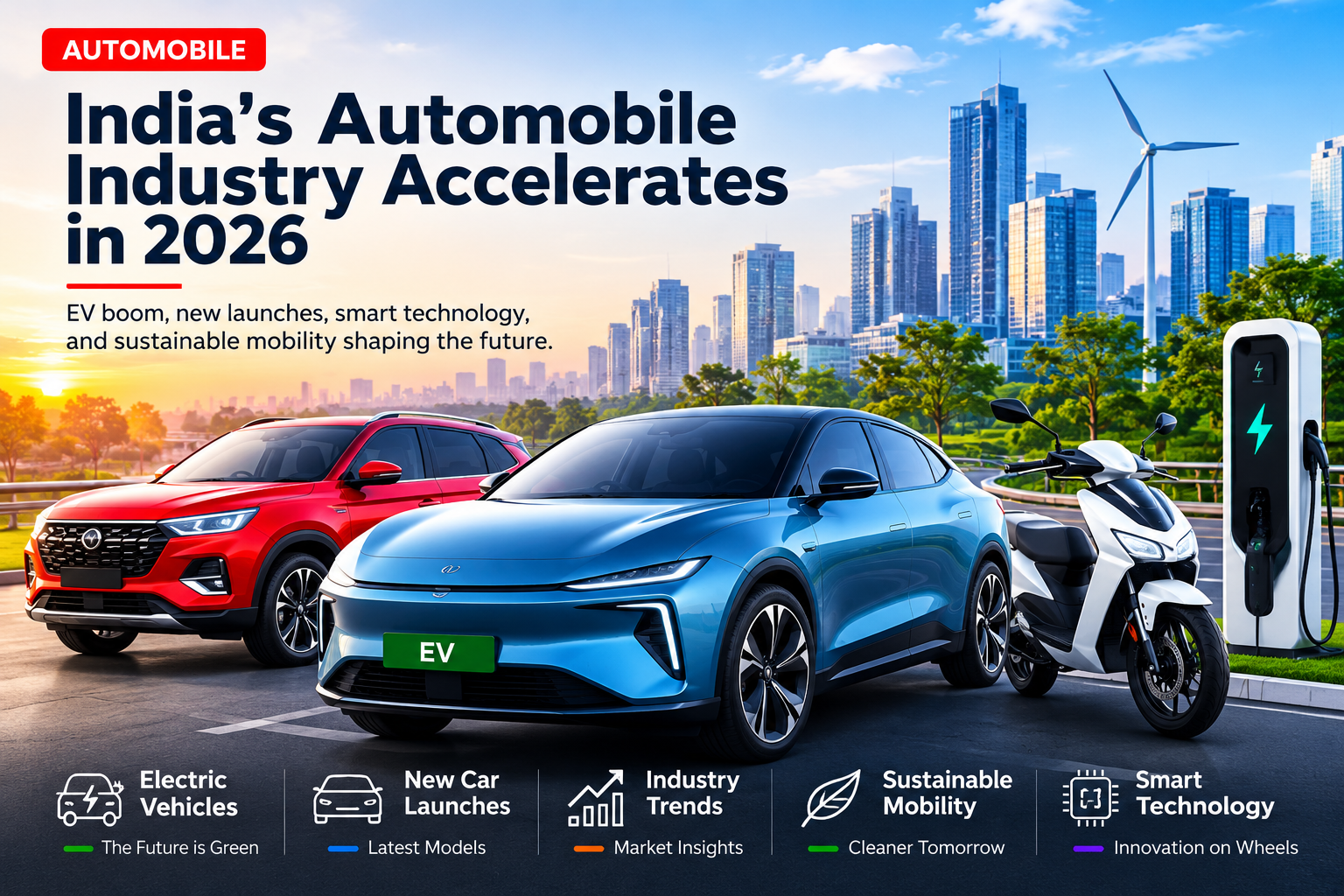
India’s automobile industry is undergoing one of the biggest transformations in its history. With electric vehicles (EVs), connected technology, and government-backed initiatives gaining momentum, the sector is moving rapidly toward cleaner and smarter mobility.
Automobile manufacturers are investing heavily in electric cars, SUVs, motorcycles, and commercial vehicles to meet growing consumer demand. At the same time, charging infrastructure is expanding across major cities and highways, making EV ownership more practical than ever before.
Electric Vehicle Market Continues to Grow
The Indian EV market has witnessed strong growth in 2026, supported by improved battery technology, lower running costs, and attractive government incentives.
Leading manufacturers are introducing new electric models across different price segments, offering consumers more choices than ever before. Battery range has improved significantly, while fast-charging networks continue to expand nationwide.
SUV Segment Remains the Most Popular
Sport Utility Vehicles (SUVs) continue to dominate India’s passenger vehicle market. Consumers prefer SUVs for their spacious interiors, higher ground clearance, advanced safety features, and premium driving experience.
Manufacturers are introducing both petrol and electric SUV models equipped with:
- ADAS (Advanced Driver Assistance Systems)
- 360-degree cameras
- Connected infotainment systems
- Wireless Android Auto and Apple CarPlay
- Multiple airbags and improved crash protection
Government Push for Green Mobility
The Government of India continues to support cleaner transportation through various initiatives promoting electric mobility, battery manufacturing, and charging infrastructure.
Policies encouraging domestic manufacturing and reduced vehicle emissions are helping India become an important global automobile production hub.
Technology Reshaping the Industry
Modern vehicles are becoming increasingly software-driven.
Automakers are integrating:
- Artificial Intelligence
- Voice assistants
- Connected vehicle technology
- Over-the-air software updates
- Predictive maintenance systems
These innovations improve safety, convenience, and the overall driving experience.
Challenges Facing the Industry
Despite strong growth, several challenges remain:
- Rising raw material costs
- Semiconductor supply fluctuations
- Battery recycling requirements
- Charging infrastructure in rural areas
- Global economic uncertainty
Industry leaders continue investing in research and innovation to address these challenges.
Future Outlook
Experts expect India’s automobile industry to continue expanding over the next decade, driven by electrification, digital technology, and sustainable manufacturing.
As consumer preferences evolve, manufacturers that prioritize innovation, safety, and environmental responsibility are likely to lead the market.
Key Highlights
- Strong growth in India’s EV market.
- SUVs remain the fastest-growing vehicle segment.
- Charging infrastructure continues to expand.
- Government policies support electric mobility.
- AI and connected technologies are transforming vehicles.
Conclusion
The Indian automobile industry is entering a new era defined by electric mobility, intelligent technology, and sustainable transportation. As manufacturers continue investing in innovation and consumers embrace cleaner mobility solutions, India is well positioned to become one of the world’s leading automotive markets.